Montáž wallboxu / Connection and inspection

Connection, circuit breaker and inspection

The part of the order that the e-shop does not sell and which determines the schedule. Here is what must happen between placing the order and the first charge.

Connection application

A wallbox increases power consumption at a location where it was previously absent. For detached houses, this usually means submitting an application to change the parameters of the supply point with the distributor, which depending on the locality is ČEZ Distribuce, EG.D or PREdistribuce. The distributor will assess the network reserve and issue a statement with conditions.

If the size of the main circuit breaker is changed, the monthly payment for its capacity also changes. When switching to a tariff favourable for charging, the electricity meter is usually replaced as well. Both require scheduling with the distributor and are the most common reasons why implementation takes weeks.

House circuit breaker and spare capacity

The 11 kW station draws around 16 A per phase, the 22 kW around 32 A. The house must also handle everything else running simultaneously. From the bill and an inspection, it can be calculated whether the reserve is sufficient or if either the circuit breaker needs upgrading or dynamic power management must be implemented.

Power management is the more cost-effective solution for most homes: the station automatically reduces charging when household consumption rises. This requires measurement at the main supply and a compatible station.
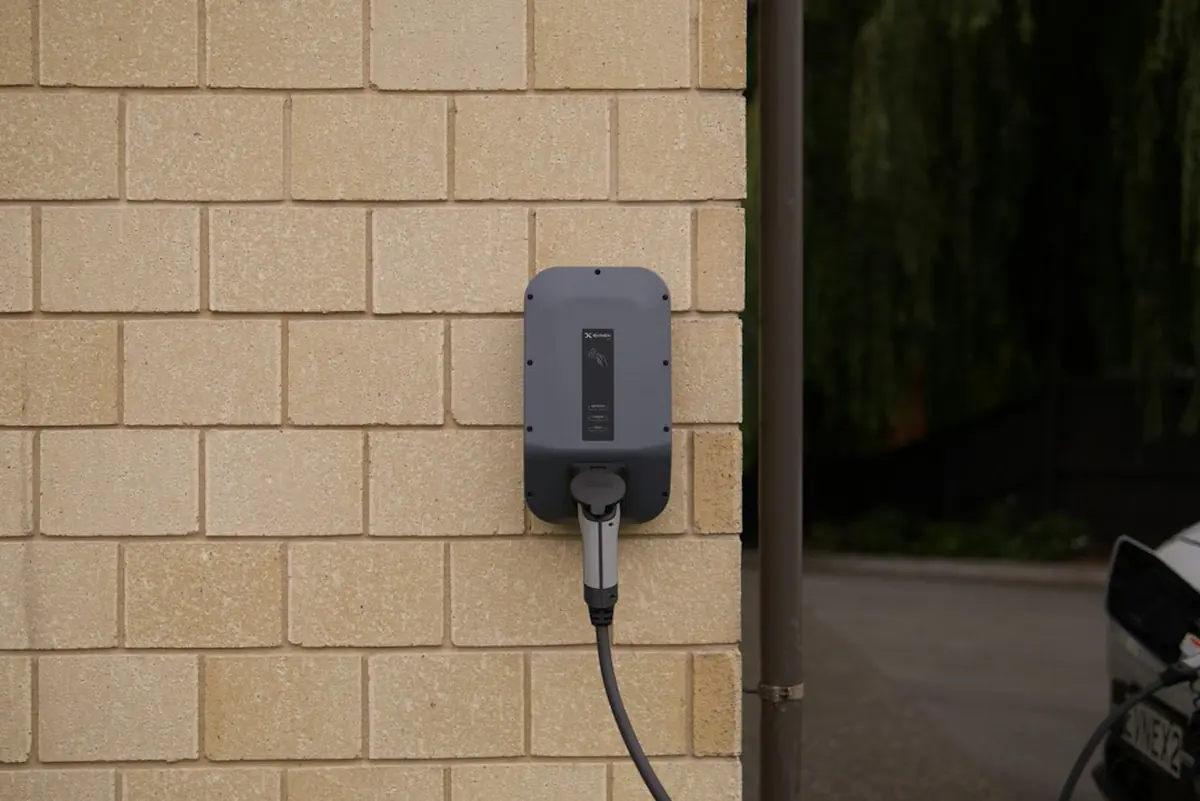
Charging connector connected to the station
Between ordering and the first charge, you need a utility network statement, circuit protection according to standard, and an initial inspection.

Circuit breaker and RCD

Charging stations require stricter protection than standard sockets. During charging, a DC component of fault current may arise, which a standard AC-type residual-current device does not detect. Therefore, a Type B RCD is used, or a Type A RCD supplemented with DC component detection, which some stations have built-in.

In addition, the supply cable size is determined by the route length and current, along with a dedicated circuit breaker and surge protection. None of this can be estimated from an office; everything must be measured on-site.

Charging from a standard socket via an emergency cable is an emergency solution, not for regular operation. The socket and its wiring are not designed for several hours of draw near rated current; repeated overloading leads to heating at the connection point.

Initial inspection and handover

The completed installation is inspected by an inspection technician who issues the initial inspection report. This verifies fusing, RCD protection, cable sizing, shock hazard protection and compliance with standards. This report is what you submit to your insurer or distributor if they ask for anything. With us it is included in the handover along with documentation and training, not as an extra charge.

Frequently Asked Questions

What is all handled with the distributor?

An application for connection or for changing the parameters of the consumption point is submitted. The distributor assesses whether the network has capacity at that location and issues a statement with conditions. If the size of the main fuse or the tariff changes, the contract and usually also the electricity meter are changed. We submit the application; you only sign it.

How long does the wait take?

This depends on the distributor, the location, and whether only parameters are being changed or the network is being modified. Allow for weeks. Therefore, we recommend submitting the request at the very beginning and scheduling the installation only after a confirmed date has been received, not the other way around.

Why does a wallbox require a dedicated RCD?

Because charging can generate a DC fault current component to which standard RCDs do not respond. The standard therefore requires either a Type B RCD or a Type A RCD supplemented with DC component detection, which the stations themselves usually have integrated. This is precisely the part that an amateur installation will omit and which the inspection engineer will find.

What does the inspection report contain and why do we insist on it?

The initial inspection verifies that the installation complies with standards, including fusing, RCD protection, cable sizing and protection against electric shock. Without it, proving the equipment was in order following an incident is difficult. The inspection is part of the handover, not an extra charge.

Related

Write to us about where this should be delivered

We only need the car model, the location for the charging station, and your main fuse rating. We will contact you within 24 hours on working days to ask further questions and arrange a site visit. The visit and proposal are free of charge and non-binding.

Prefer to call?

Call on working days and we'll go through it together in ten minutes.

775 654 443

[email protected]

  • We handle the distribution company's consent for connection, not just installation.
  • Free inspection of the site and cable route.
  • The inspection report and documentation are part of the handover.
  • Installation by a trusted team from your region, throughout the Czech Republic.